


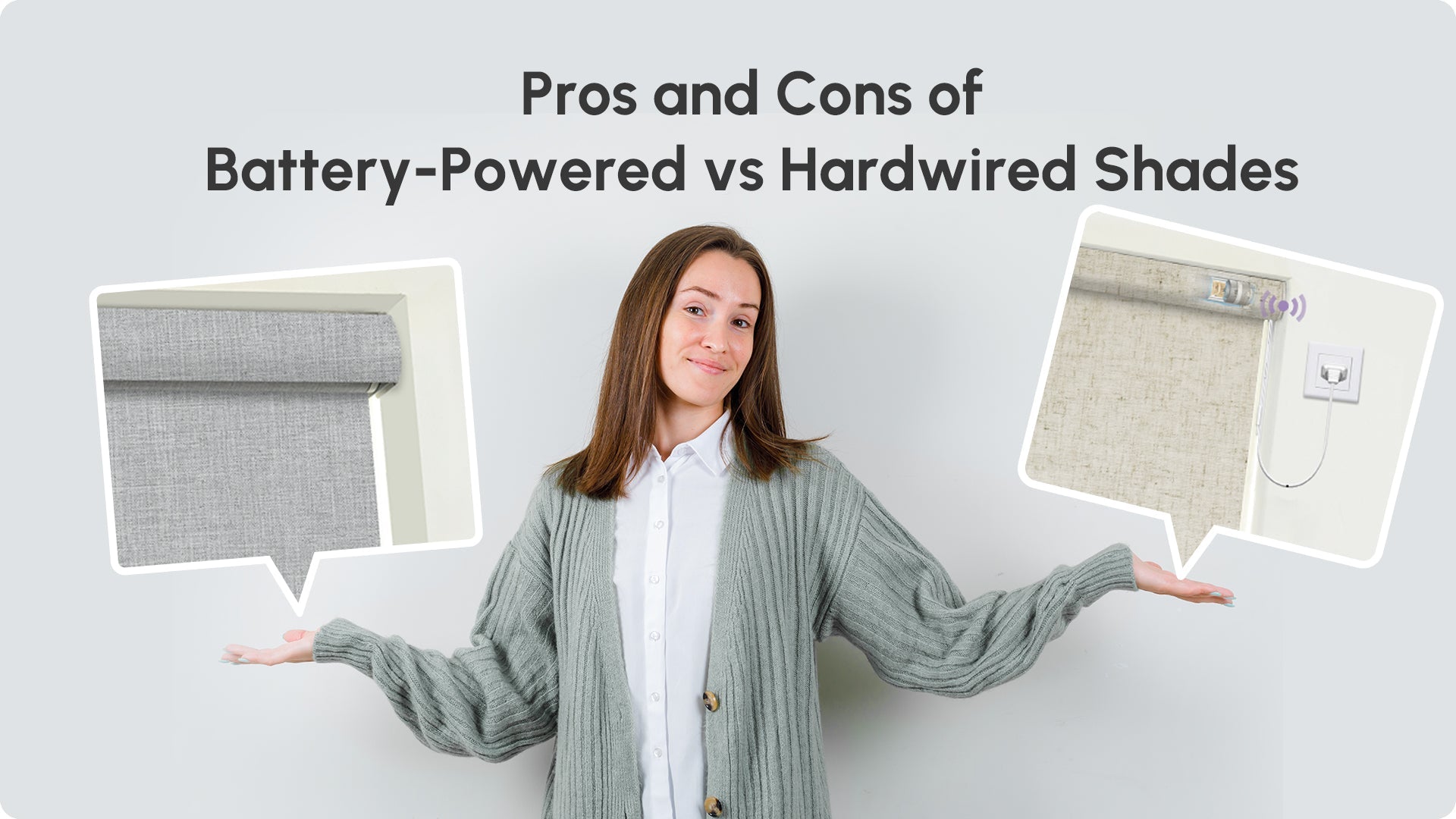
Want to upgrade your home with electric blinds, but now comes the final, crucial technical choice: battery vs hardwired motorised blinds? This comprehensive guide will break down the pros, cons, and key factors to consider, helping you make the perfect choice for your home.

Why Choose Motorized Blinds?
Before we dive into the technicalities, let's quickly recap why motorised blinds are a fantastic investment:
- Ultimate Convenience: Control your blinds with a remote, smartphone app, or voice commands via Google Assistant or Alexa.
- Enhanced Energy Efficiency: Automate your blinds to open and close with the sun, reducing heating and cooling costs.
- Improved Safety & Childproofing: No more dangling cords, creating a safer environment for children and pets.
- Perfect for Hard-to-Reach Windows: Effortlessly control skylights, high windows, or windows behind large furniture.
- Smart Home Integration: Seamlessly integrate with your existing smart home ecosystem for automated scenes and routines.
Battery-Powered Motorised Blinds: Wireless Freedom
Battery-operated blinds are exactly what they sound like—they run on batteries, typically standard or rechargeable lithium-ion packs housed within the blind's headrail.
Pros of Battery-Powered Blinds:
- Easy Installation & Retrofit-Friendly: This is the biggest advantage. You can install them anywhere, exactly like manual blinds. They are the perfect solution for existing homes where running new electrical wires is difficult or expensive.
- No Unsightly Wires: The clean, wireless look maintains your aesthetic without any visible power cables.
- Flexibility & Portability: You can easily move them to different windows if needed.
- Simple Power Solution: For windows located far from power outlets, batteries are often the only practical option.
Cons of Battery-Powered Blinds:
- Ongoing Maintenance: You must remember to recharge or replace the batteries. Depending on usage, this can be every 6 to 24 months.
- Potential for Dead Blinds: If the battery dies, you lose functionality until it's recharged or replaced.
- Slightly Bulkier Headrail: The compartment for the battery can make the headrail a little larger than that of a hardwired model.
Why Choose Them? Choose battery-powered blinds if you're looking for the easiest installation, have an existing home, or your windows aren't near power sources.

Hardwired Motorized Blinds: A Permanent Power Solution
Hardwired motorized blinds are connected directly to your home's electrical system, much like a ceiling light fixture.
Pros of Hardwired Motorized Blinds:
- Uninterrupted Power: You never have to think about charging or replacing batteries. They are always on and ready to use.
- Zero Maintenance: Once installed, there are no ongoing power-related tasks.
- Sleeker Profile: Without a battery compartment, the headrail can often be more compact and discreet.
- Ideal for High-Usage Areas: Perfect for large or frequently adjusted blinds where constant battery drain would be an issue.
Cons of Hardwired Motorized Blinds:
- Complex Installation: Installation requires running wires through your walls to a power source, which usually necessitates professional help, especially in finished homes. This is best planned during new construction or a major renovation.
- Higher Upfront Cost: The cost of an electrician and the more complex installation process can make the initial price tag higher.
- Inflexibility: Once installed, they are difficult to move or relocate.
Why Choose Them? Choose hardwired blinds if you are building a new home, undergoing a major renovation, want a "set it and forget it" solution, and prioritize a seamless, maintenance-free experience.

How Do They Work?
Both types use a small, quiet motor inside the headrail to rotate the blind's tube, raising or lowering the shade fabric. The core difference is the energy source:
- Battery-Powered: The motor draws power from the integrated battery pack, which is controlled wirelessly via RF (Radio Frequency) or Wi-Fi signals.
- Hardwired: The motor is connected to your home's low-voltage wiring, receiving constant power and communicating via similar wireless protocols.
Head-to-Head Comparison: Battery-Powered vs. Hardwired Shades
|
Feature |
Battery-Powered Blinds |
Hardwired Motorized Blinds |
|
Installation |
Easy, DIY-friendly. Retrofit perfect. |
Complex, often requires professional electrician. |
|
Upfront Cost |
Lower |
Higher (includes wiring & labor) |
|
Long-Term Cost |
Cost of battery replacement/recharging |
No ongoing power cost |
|
Maintenance |
Periodic battery management |
Virtually none |
|
Reliability |
High, but dependent on battery life |
Maximum, with constant power |
|
Aesthetics |
Clean, no wires (but potentially bulkier) |
Very clean and discreet headrail |
|
Flexibility |
High; easy to relocate |
Low; permanent installation |

Key Factors to Consider When Choosing
- Your Home's Situation: Are you building new, renovating, or living in a finished home? This is the single biggest factor.
- Your Budget: Consider both the upfront cost (blinds + installation) and any potential long-term costs.
- Your Technical Comfort: Are you a confident DIYer, or do you prefer to have everything professionally installed?
- Number of Windows: For a single window, battery power is simple. For a whole house, the convenience of hardwiring might be worth the initial investment.
- Desired Level of Automation: If you plan on complex, multiple-times-a-day schedules, the reliability of hardwired power can be more reassuring.
How to Choose the Right Motor
At Graywind, we offer both options to suit your needs. Your choice ultimately comes down to your priorities:
- Choose Battery-Powered Blinds if: Your top priorities are easy installation, flexibility, and lower upfront cost.
- Choose Hardwired Motorized Blinds if: Your top priorities are zero maintenance, maximum reliability, and you are in a construction/renovation phase.
Cost Analysis: Upfront vs. Long-Term
- Battery-Powered Blinds:
- Upfront: Lower cost. You pay for the blinds and the motor system. No electrician fees.
- Long-Term: Minimal cost for electricity to recharge the battery or for purchasing replacement batteries over many years.
- Hardwired Motorized Blinds:
- Upfront: Higher cost. You pay for the blinds, the motor system, plus the cost of an electrician and materials for wiring.
- Long-Term: Virtually no additional cost. The power draw is minimal and is part of your home's electricity bill.
A Smart Hybrid: Solar Panel Blinds
Can't decide between the freedom of batteries and the convenience of constant power? Consider the best of both worlds: window blinds with solar panels.
Graywind offers innovative solar-powered solutions where a small, discreet solar panel is attached to your blind. It continuously charges the built-in battery using natural light, effectively creating a self-sustaining system. This eliminates the need for wiring and the hassle of manual recharging, making it an incredibly efficient and eco-friendly choice for sun-rich rooms.
The Bottom Line
The choice between battery vs hardwired motorised blinds ultimately comes down to your home, your project, and your personal preference.
- Choose Battery-Operated Blinds for ease, flexibility, and a perfect retrofit solution.
- Choose Hardwired Motorized Blinds for a permanent, maintenance-free installation in new constructions.
- Consider Solar Panel Blinds for a hassle-free, eco-conscious alternative that combines the benefits of both.

No matter your choice, Graywind provides high-quality, reliable motorisation options to transform your house into a smarter, more comfortable home.


